

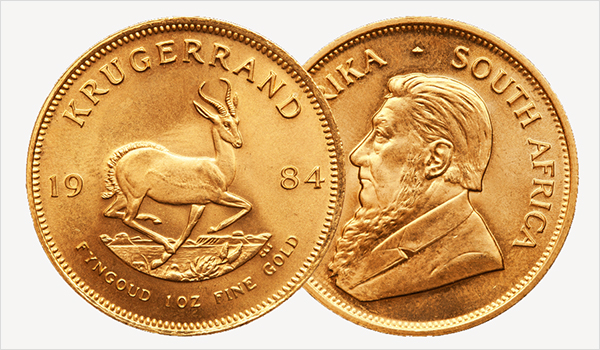
Learn more about the 1-oz and 22-k South African gold bullion coin. The Krugerrand is a gold coin from South Africa. It was named after Paul Kruger, the former South African President whose bust is depicted on the krugerrand’s obverse.
The legend “SOUTH AFRICA” and “SUID-AFRICA”, which is the Africaan name for the coin’s region of origin, are also inscribed on the heads side.
The reverse is adorned with a graceful springbok, an African gazelle. The legend “KRUGERRAND”, the mint date, and the purity of the South African Krugerrand – both in English and in Africaans – are also inscribed on the reverse.
The Kruggerand has a legal tender, meaning it can be used to purchase goods and services. However, the Kruggerand does not have a face value unlike other coins.
Instead, its face value is converted to the bullion value based on the current price of gold. The Krugerrand was meant to be circulated in the South African currency.
Back in 1967 when the gold Kruggerand was introduced, it was the first coin to have such unusual legal tender.
The Kruggerand was also the first gold coin to contain one ounce of fine gold. As a gold bullion, a Kruggerand coin was sold with a five percent premium (the dealer’s mark up price added to the original coin value).
At 32.6 mm in diameter and 2.74 mm thick, the Krugerrand weighs 1.0909 troy ounces (33.93 g). Even if the Kruggerand contains an exact amount of one troy ounce (31.1035 g) of gold, it is alloyed with other base metals to make it more durable. Hence, the gold Krugerrand is 91.67% pure or 22 karats.
The Kruggerand has an orange-tinged gold color due to its copper alloy. Rand Refinery Limited, the biggest gold refinery in the world, owns the registered trademark for the word “Krugerrand”.
Years after it was launched, the South African Krugerrand ruled the gold bullion market. Gold coin investors had a great demand for the Kruggerands because of its one ounce precious metal content.
Thus, many nations followed suit and then came the Canadian Maple Leaf Gold coin (1979), the Australian Nugget coin (1981), the Britannia gold coin (1987), and the American Gold Eagle coin (1986).
In 1980, the Kruggerand was added with three other gold denominations: the half ounce, quarter ounce, and the tenth ounce. All denominations were still at 22 carat or 91.67% fine gold.
Aside from the Krugerrand bullions, coin collectors can also purchase Krugerrand proof coins. The distinguishing mark of the non-proof and the proof Krugerrands are the serrations or the fine teeth-like marks bordering the rim of the coin. Proof Krugerrands have 220 serrations while the bullion Krugerrands only have 180 serrations.
Many fake gold coins have found their way to the numismatic market. The Krugerrands, too, have been copied unlawfully.
The illegal minting and distribution of silver Krugerrand coins are prohibited by the South African government. The silver Krugerrands are not certified and therefore, they are not legal tender.