

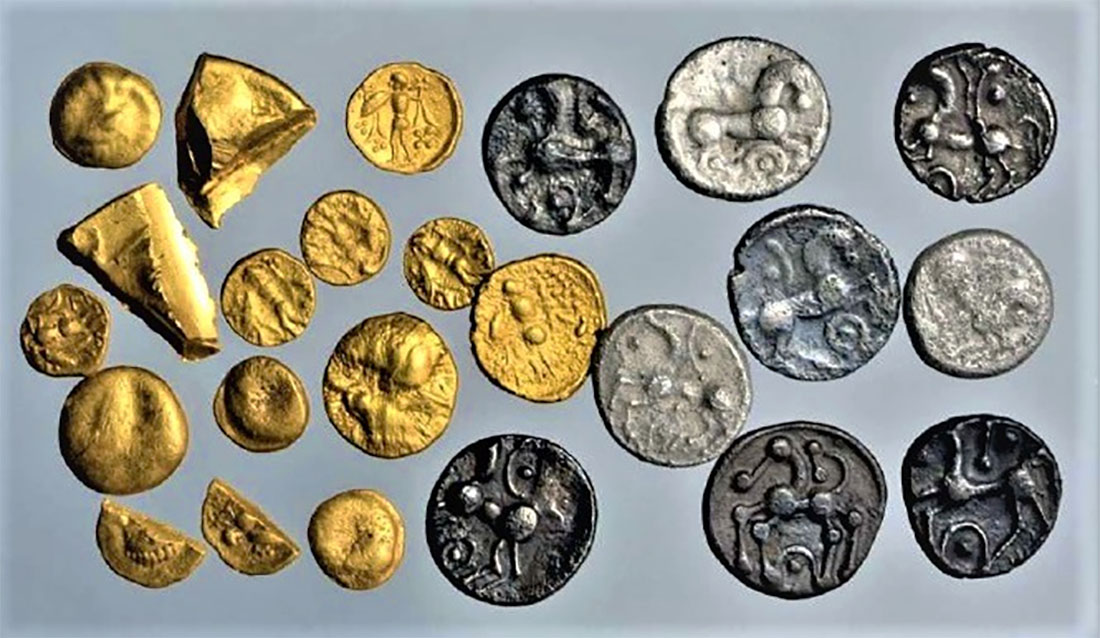
Celt tribes minted their own ancient coins creating a diversity of Celtic coins. The minting of Celtic coins started with the Celts of Gaul and spread into other Celtic tribes through trade and migration.
Its 350-year history produced many varieties of coins that reflect the Celts’ arts, culture and society. Ancient Celtic coins are divided into two main categories: Gaulish and British.
These are further subdivided into specific tribes that produced the coin, which numbers to more than a hundred.
Continental or Gaulish coinage refers to coins produced by the Celts of Gaul (roughly modern France) between 4th century BC and late 1st century B.C.
Early continental Celtic coins exhibit designs based on the gold stater of Philip II of Macedon, father of Alexander the Great, from the mid-4th century B.C. The obverse illustrates an idealized head of Apollo and on the reverse is a two-horse chariot with Philip’s name below.
The coin patterns slowly evolved to include Celtic art. The idealized head of Apollo became simplified heads of tribal leaders; later becoming abstracted figure representing a head. The two-horse chariot on the reverse developed into a single horse, and then a horse with other Celtic icons.
Notable Gaulish groups that produced Celtic coins are the Treveri, Remi, Sequani and Parisii tribes.
Celtic coinage in Britain was produced from the late 2nd century B.C. to the mid-1st century A.D. These coins are said to be the final artistic and technical prosper in almost four centuries of Celtic coinage.
The first coins minted in Britain, usually made of cast bronze (potin), were based on the coins of Massilia (Marseilles)which had the head of Apollo on the obverse and a charging bull on the reverse.
British Celt coins have a visible human profile on the obverse soon replaced to favor the wreathed head of a king. On the reverse, the stylized horse is as widespread as other Celtic symbols (ropes, chariot, wheel, ear of wheat, etc.).
The Iceni, Brigantes, Regni and Trinovantes tribes are some of the many tribal communities that produced the finest of Celtic coins.
The Roman invasion marked the end of the British coinage. After gaining control of most Celtic tribes, Roman coins were imposed into the Celtic monetary system.