

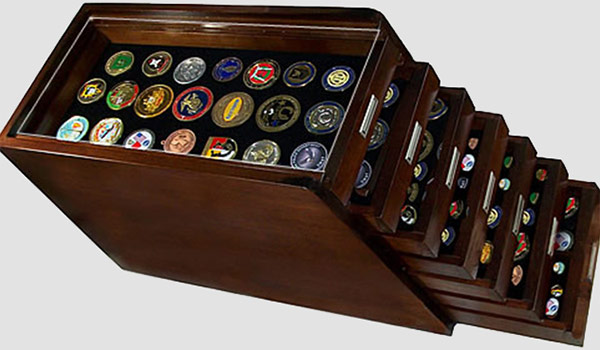
Numismatic & coin collecting supplies guide on proper coin display and storage
Coin display cases are compartments made from transparent materials, such as glass or plastic. They are used so that the coin collection can be viewed.
Coin collectors are storing their coins in large transparent display cases. Unlike cabinet-type drawers, coin display cases save the time checking the condition of the coin.
You do not have to physically remove the coin from its storage for evaluation. In this way, coin display cases avoid the coins from unintended drops, friction with other coins and contact with human skin.
Types of collector coin display cases
Coin display cases come in different shapes and sizes. They can also be customized so that they would fit neatly into your homes. Below is a list of popular types of collector coin display cases:
1.) Box coin display case
The simplest of all coin display cases, the box type is walled by plastic or glass. The coin is usually mounted on a stand. The box coin display case is ideal as a mantel or table top piece. There are several designs that you can choose from:
Dome coin display case is another popular design. Instead of a rectangular walls and top, it is made of glass or plastic cylindrical encasement with a rounded or “dome” top.
Coin display cube is the simplest coin display case. The coin is encased inside a box which has transparent walls and top and mounted on a wooden stand. It is called double sided because you can see the obverse and reverse faces of the coin.
2.) Rack coin display
The rack coin display case is similar to the box coin display case; however, the rack type can accommodate two or more coins. Coins are laid flat on a surface or filed in a vertical row. Here are some of the typical varieties:
Single row rack coin display case is popular for its simple design. Coins are arranged one by one in a single row.
Wall mounted coin display case
This display is also called framed coin display case. It can either be a flat, slotted surface or fitted with several layers of rows.
Shelf coin display case
This case is a larger version of the wall mounted coin display case. The shelf type is a standalone compartment fitted with several racks.
Curio coin display case
This display case is similar to shelf coin display case; however, the curio type is columnar in design. The curio display case is most often used in museums in displaying coins.
3.) Coin display table
Also called tray coin display case, coin display cabinet is a larger version of the row type.
The coin display cabinet is a table covered in velvet or special cardboard where coins are laid into rows and columns and protected with glass walls.
4.) Slotted coin display case
It is similar to the one you see in museums, but each coin has a slot. The coins, especially those that are ‘slabbed’ or packed in individual coin holders, are arrayed into rows and columns.
5.) Coin Presentation Box
The coin presentation box is a portable coin display case. It is made of aluminum, tempered glass window or wood. Most coin presentation boxes are in the form of attaché cases. They are used as a convenient storage box so that the coin collection can be carried anywhere.
Coin display case materials
Glass, acrylic, and wood are the most common materials in making coin display cases. Each of these materials has both negative and positive characteristics for preservation of coins. Below is an evaluation of the properties of these materials:
Glass
Glass is a transparent material made from silica (SiO2). It is suitable for coin display case because it is non-reactive. The glass can be coated with special filters so that the coins are not exposed to direct sunlight.
The disadvantage with glass is that it is unwieldy and susceptible to break.
Acrylic
Acrylic is a synthetic plastic that is a good substitute to glass. Acrylic is lighter, durable and more flexible. Like glass, acrylic is non-reactive. It can be treated to redirect the rays of the sun. Unlike glass, acrylic does not break into sharp, pointy shards.
Acrylic coin display is also called Perspex, plexiglass or Lucite coin display case. The disadvantage of acrylic is that it discolors to a yellow tinge over time. To address this problem, acrylic undergoes a special anti-yellowing treatment during manufacturing.
Wood
Some parts of the coin display case are made of wood, particularly the frames, sidings and base. Mahogany is the common choice for wood. It gives off minimal acidic vapor over time. It also lacks harsh oils and resins that can tarnish or oxidize coins. Wood in coin display case is lacquered for further protection.
What is the best coin display case?
The most important issue for coin collectors is how to choose the best coin display case. Experts say that there is no single answer for this. Good coin storage ultimately depends on many factors: coin design (i.e. diameter, thickness, metal, minting process); the place of storage; and how you want to display your coin collection.
The box coin display cases are suitable when you want to highlight a single coin. Therefore, they are very good in displaying proof coins or error coins. You can also encase mint-state coins and commemorative coins in individual coin display cases, which you can then place on tabletops or mantels.
On the other hand, rack coin display cases are appropriate for coin collecting set where you have several coins to be displayed. The curio and shelf types, particularly those with layered racks and drawers, are best for really large coin collections.
The coin presentation boxes are fit for people who carry their coin collection in their travels such as curators, dealers, traders and collectors attending coin shows. The coin presentation box is also great in carrying coin collecting gifts for your family and friends.
Tips on how to buy coin display cases
One way of earning money from coin collecting is to store old coins for a long period and then sell them at a profitable price. Thus, you need to buy coin display cases that have the capability for long-term storage of coins. Here are the tips on how to buy coin display cases:
1. Demand for a hermetically sealed coin display case
Coin display cases must be airtight and watertight. The seams and corners of glass and acrylic can be sealed with caulking materials. This is very important, as oxides in water and pollutants in the air can be harmful to coins.
2. Buy secure, lockable coin display case
Protect your coin collection from getting stolen by buying coin display cases with security devices: locks, magnetic mechanisms, burglar alarm system, etc.
3. Look for coin display case treated with anti-yellowing agent
Acrylic will discolor into rusty yellow in the passing of time. To minimize cost and improve clarity, buy only those that have been treated with anti-yellowing agent.
4. Check the fire rating of the coin display case
Coin display cases are the only protection you have against fire accident. Have the time to check their fire rating. Please check your country’s fire rating standards on glass and acrylic products for more info. In this way, you can be assured that your coin collection has less risk of damage in case of fire breakouts.
5. Prefer coin display cases that are aesthetically pleasing
Of course, go for beautiful coin display cases that highlight your coin collection. There are many designs that can suit anyone’s tastes: choose from richly embellished to sparse minimalist display cases.
How to store coins in coin display cases
Buying state-of-the-art coin display cases would not provide protective benefits to your coin collection if you do not take care in displaying your coins. Here are the tips on how to properly store coins in coin display cases:
1. Have a coin filing system
Storing many coins in a display case needs an organized filing system. You can store coins into many categories: denomination, age, country, etc. But the most important thing is to place coins of similar metal types together.
Each metal (silver, nickel, gold, bronze and copper) requires unique coin maintenance. So if you gather all gold or silver coins in one case, it would be easier to properly take care of them.
2. Buy special coin protective holders
Encase your coins individually before storage. You can buy coin protective holders from coin collecting supplies shops. Just make sure that the coins will not be scratching or come in contact with one another.
3. Install a hygrometer
Install a hygrometer inside the coin display case. A hygrometer is an instrument that measures the humidity of an enclosed space. In this way, you can monitor the
4. Put a desiccant in coin display case
A dessicant is a chemical substance that is inert (non-reactive) and absorbs moisture. Silica gel is the widely used dessicant. One pound of silica gel is suitable for every 20 cubic feet of enclosed space. Recycle the silica gel by hanging it or drying it in direct sunlight every three months.
5. Use a coin dehumidifier
Coin dehumidifier is useful during summer or when you keep your coin collection in the basement or a crawl space dehumidifier can absorb moisture from the air and keep the humidity around 30% all year round.
6. Place a bar of corrosion inhibitor in coin display case.
Corrosion is caused by interaction of substances in the air and the metal surface of the coin. A corrosion inhibitor, as the name implies, makes it harder for any corrosion to take place. It is a chemical compound that disperses and develops a protective film on the surface of the metal coin.
Corrosion inhibitor brands have different efficiency and effects on coin. It is important to check product information before buying. A bar of Metal SAFE, for instance, can be used for one year as a protection for 33 cubic feet of enclosed space.