

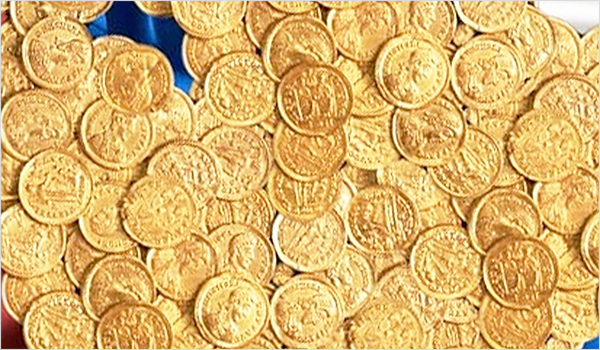
Read about the gold coins from Russia from their ancient, Imperial, and Communist periods. Russian gold coins reflect the grandiosity of the old empires in Russia. Every coronation of a new tsar also signals a new coinage.
The Russian government has a record of the total number of gold coins it has produced from the 10th to 18th century. However, no one really knows for sure how many of the Russian gold coins have survived today.
It was not until the recent times that many Russians became interested in numismatics. Post-war Russia was more concerned in reconstructing its economic stability.
The extravagant hobby of coin collecting did not appeal to many Russians. During the trying times, many Russian gold coins were melted for their gold melt value.
Brief history of the Russian gold coinage
In numismatic history, Russia was the last country to stop using the medieval method of hammering coins. However, Russia was also the first country to adopt the modern decimal-based coinage.
The ancient Russian gold were minted and imported from the neighboring European countries. These gold coins were crudely minted from the 10th to 18th century. Before 1745, Russia did not know its vast gold reserves until it was discovered in the Ural Mountains. Since then, there was a steady production of Russian gold coins in the succeeding years.
The Imperial Russian gold coins were mostly produced by the aristocrats from the 18th century to 1917. The Russian soviet was in power from 1917 to 1992 and it was minting a few gold coins for their currency. After the communist state, the new Russian republic began minting gold bullion coins.
The first Russian gold coins
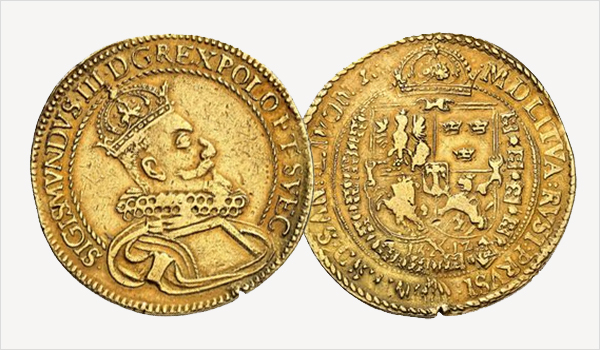
The first Russian coin was called the “zlatniki” which means “a piece of gold” in Russian. It was struck for Vladimir, the Grand Duke of Kiev.
Other early Russian gold coins were the kopeks, poltinas, ugorski and novodels. However, most of the first Russian gold coins did not have a legal tender. They were mainly for awards during the hunting season and as trade coins.
In 1612, the gold ducats were circulated in Russia and also in Holland and Sweden. The ducats were gold coins were made in Austria and were exported to other nations.
The Chevronets
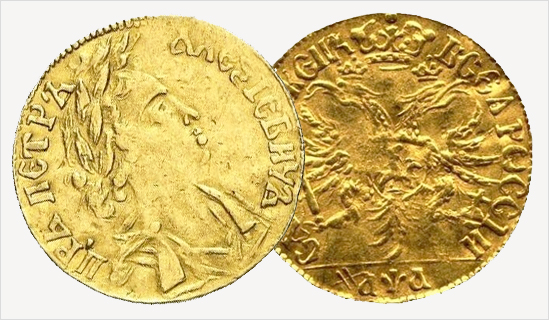
In 1701, the first Russian chevronets or ugorski were minted. The chervonet was the collective name for various foreign gold coins circulated in Russia before the reign of Peter I. The chevronets were also called tchervonets, chevervontsy, and czerwony.
The gold chervontsy were mostly composed of Dutch ducats and sequins. They were minted until 1757 until they were displaced by the gold rubles.
The gold Roubles
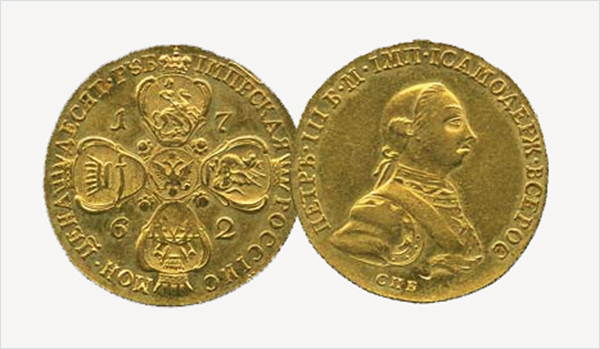
Russia changed coinage in 1704 to give way to the Roubles or rubles. The first circulated Russian gold coins were produced during the regime of Peter I, the Great.
When the St. Petersburg Mint was established in 1724, Peter, the Great made a nominal decree to mint gold coins. The striking discovery of the Russian gold reserves in the Ural Mountains also paved the way to the production of more gold roubles.
The first 10 Rouble gold coin was introduced by Tsarina Elizabeth Petrowna. By 1755 The 20 Rouble coin was in the mainstream circulation among the important European coins from France, England, and Netherlands. The gold 5 Rouble and 10 Rouble coins were also circulated.
The popular Russian imperial coins are the following:
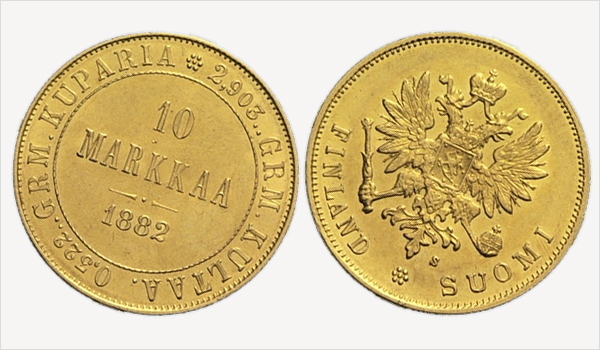
- Alexander III – Gold 10 Markkaa 1882
- Nicholas II – Gold 20 Markkaa 1912
- Nicholas II – five rubles 1897
- Nicolas II – five rubles 1898
- Nicolas II – five rubles, 1900
The revival of the Chervontsy
When Russia became a communist state in 1922, the new currency was renamed chervonets. The Soviet Russian currency was backed by the gold standard.
Gold chervonets that were equivalent to 10 Roubles were minted in 1923 (under the RSFSR) and 1925 (under the USSR). Today, only five chervontsy pieces dated 1925 have survived. These chervonets are displayed in Russian museums that house the famous coin collections.
In 1980, thousands of 1920 chervontsy restrikes, with a face value of 100 Roubles, were made as commemorative coinsfor the Moscow Summer Olympics. The new chervonets became a big hit among gold coin investors.
The modern Russian gold bullion coins
The present Russian Federation has a notable series of three gold bullion coins. These Russian gold coins feature the Russian ballet, the Russian wildlife, and the zodiac signs.
The word gold coin bullion market has a strong demand for Russian gold bullion coins. However, just like the Russian numismatic gold coins, they have a low supply.